
Standing-wave ratio (SWR) describes how well the antenna system is matched to the radio and feed line. It is a useful diagnostic tool, but low SWR alone does not guarantee an efficient antenna.
What SWR numbers mean
- 1.0:1: a perfect indicated match at the measurement point.
- About 1.5:1: generally a good result for many practical installations.
- 2.0:1 or higher: worth investigating for the particular radio and antenna. Follow the radio manufacturer’s limits before transmitting.
Measure SWR with an inline meter
- Turn the radio off and connect the meter according to its TX/RADIO and ANTENNA labels.
- Use a clear channel and keep transmission short.
- If your meter has a calibration function, select FWD/CAL, key briefly and adjust to the calibration mark.
- Switch to REF/SWR and read the indicated value.
- Repeat on a low channel and a high channel, documenting both readings.
How to interpret low vs high channel readings
For many adjustable vertical antennas, a lower SWR on the low channels and higher SWR on the high channels suggests the radiator may be electrically too long. The opposite pattern can suggest it is too short. Verify against the manufacturer’s instructions, because different antennas and matching networks behave differently.
Before cutting the antenna
Inspect the mount, ground-plane connections, coax shield, connector soldering, water intrusion, physical antenna damage and proximity to conductive objects. Poor grounding and defective coax can make adjustments misleading.
Common mistake: confusing SWR with range
A matched dummy load can show a wonderful SWR while radiating almost nothing. Antenna efficiency, placement, height and surroundings still determine whether your signal gets out.
Related: CB antenna selection and installation.
What to do when readings stay high
Verify the antenna is designed for CB frequencies, that the meter is wired correctly and that there are no damaged connectors. An analyzer may be more informative than a basic in-line meter. If the reading remains unsafe, stop transmitting and fix the cause.
SWR explained: measure it safely and interpret the result
A practical station-check procedure with the reasons behind each meter reading.
What SWR measures
Standing-wave ratio compares voltage maxima and minima in a feed line caused by a mismatch. In a simple 50-ohm system, 1:1 indicates a perfect match at the measurement point; it does not measure antenna radiation efficiency or signal quality.
Many CB radios can operate with some mismatch, but consult the specific manufacturer’s limit. If the reading rises suddenly or approaches the red end of the meter, stop transmitting while you inspect cables and connectors.
How to use an inline meter
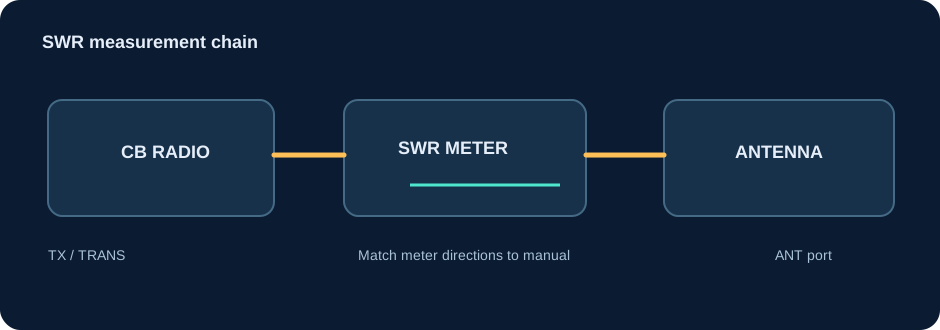
With the transmitter off, place the meter between the radio output and antenna feed line. Connect the transmitter to the meter’s TX or TRANS jack and the antenna to the ANT jack. Select a clear channel and an appropriate low-power setting.
For a typical CAL/FWD/REF meter, key briefly on AM, calibrate the FWD or SET position according to its manual, switch to REF/SWR, then read the ratio. Release the key, repeat on Channel 1 and Channel 40, and record the values. Never transmit into an open cable or touch exposed RF connections.
How to interpret a mismatch
A 2:1 SWR corresponds to a reflection-coefficient magnitude near one third and about 11% reflected power at that point on an ideal lossless line. Reflection does not mean all that energy is permanently lost; real efficiency depends on feed-line loss and transmitter behavior.
Before cutting or adjusting an antenna, verify the correct meter direction, antenna counterpoise, coax continuity, connectors, and nearby metal. Recheck after every small mechanical adjustment.
At-a-glance reference
| SWR | Approx. reflected power* | Practical interpretation |
|---|---|---|
| 1.0:1 | 0% | Ideal indicated match |
| 1.5:1 | 4% | Often acceptable |
| 2.0:1 | 11.1% | Investigate if outside radio guidance |
| 3.0:1 | 25% | Stop and diagnose before prolonged transmission |
*Approximate ideal lossless-line reflected-power fraction derived from |Γ|²; actual feed-line efficiency depends on loss and radio behavior.
Frequently asked questions
Does 1:1 SWR guarantee an efficient antenna?
No. The meter measures impedance matching at one point, not radiated power.
Should I adjust the antenna or the coax length?
Normally diagnose the mount and tune the antenna first; avoid treating coax length as a universal SWR cure.
Can an SWR meter damage my radio?
An incorrectly connected meter, bad connector or severe mismatch can create problems. Always power down while changing connections.
